

01
Collect the fees
harvest()
Every $KSTR trade on Montra pays a 2% fee. Montra keeps 0.4%; 1.6% flows into the vault's fee lane, split 90% to the NFT fund and 10% to the team.
- Fees waiting
- —
- Harvested
- —

On Elysium · launching on Montra
On Elysium · launched on Montra
Kalos Strategy turns $KSTR trading fees into Kalos Genesis, relists them at 1.20×, and burns $KSTR with every sale. Run by anyone. Withdrawable by no one.
…
The contract address is published here at launch. Any other "CA" is not ours.
Live numbers appear here the moment the vault goes live.
The collection
Owned by the vault and sold only here, straight from its contract. Each price eases toward its floor until someone buys.
 Kalos Genesis
Sold by the vault
Price, low to high
Opens at launch
The first Kalos Genesis appears here the moment the vault buys it, priced at 1.20× its cost and easing to 1.05× over 7 days.
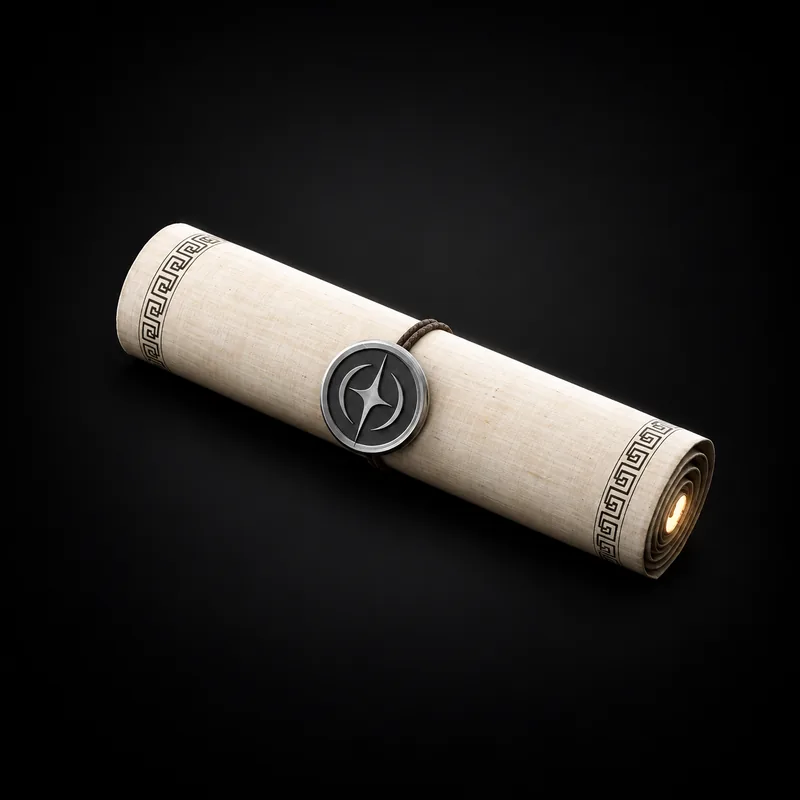
All 1,500 Kalos Genesis share one artwork: a parchment scroll with a Greek-key border.
The flywheel
Four public functions keep it turning. Anyone can call them. Nobody can take the money out.
harvest()
Every $KSTR trade on Montra pays a 2% fee. Montra keeps 0.4%; 1.6% flows into the vault's fee lane, split 90% to the NFT fund and 10% to the team.
buyKalosListing()
The vault buys Kalos Genesis listed on Kalos' marketplace at or below its bid cap: 90% of the last price, rising 5% of it every hour, never above the fund.
buyFromVault()
Every NFT the vault buys is for sale here at once, at 1.20× its cost, easing linearly to 1.05× over 7 days.
processBurn()
Sale proceeds buy $KSTR on Montra in chunks of up to 1, one every 60 s, sent to 0x…dEaD forever. The caller earns 0.5%.
Drive the vault
The loop never waits for a team. Push it forward from here, on Elysium, and keep the reward when you burn.
Fill a listing
Anyone can make the vault buy a Kalos Genesis listed on Kalos' marketplace at or below the bid cap with buyKalosListing(seller, id, price). The vault checks the outcome: it must receive the NFT and pay no more than the cap.
harvest()Pull the fee lane into the vault: 90% to the NFT fund, 10% to the team.
processBurn()Spend the next chunk of sale proceeds on $KSTR and send it to 0x…dEaD.
Ledger
Its latest moves, read straight from the chain. Every line links to the explorer.
Activity appears here after launch.
| Parameter | Value | Hard limit |
|---|---|---|
| Relist price | 1.20× cost | 1.10–3.00× |
| Floor price | 1.05× cost | 1.00× to relist |
| Price decay | 7 days | up to 90 days |
| Bid start | 90% of last buy | 50–100% |
| Bid growth | +5% / hour | 0.5–20% / hour |
| Burn chunk | 1 | 0.001–1,000 HYPE |
| Burn interval | 60 s | up to 1 day |
| Caller reward | 0.5%, max 0.01 | up to 1%, max 0.1 HYPE |
| Team share | 10% of fees | fixed at deploy |
FAQ
A token, $KSTR, whose trading fees run an on-chain vault on Elysium. The fees buy Kalos Genesis NFTs, the NFTs are resold at a markup, and the proceeds buy back and burn $KSTR. One contract, the KalosStrategyVault, enforces the loop, and anyone can drive it.
Kalos is ancient Greek for beautiful. The vault collects Kalos Genesis, a collection on Elysium, one trade at a time.
$KSTR launches on Montra with a 2% fee on every buy and every sell. At launch, Montra's anti-snipe fee starts buys at 99% and lowers it to 2% over 30 minutes. Montra keeps 0.4%; the other 1.6% goes to the token's fee lane, which points at the vault. Each harvest sends 10% of that income to the team (a share fixed forever in the contract) and 90% to the NFT fund.
Through a rising bid. Right after a purchase, the vault's bid cap is 90% of what it just paid. Every hour the cap grows by 5% of that price, and it can never exceed the NFT fund. Listings at or below the cap can be filled; anything above waits. The vault discovers the floor from below instead of overpaying one seller.
Each NFT is listed by the vault itself at 1.20× what it paid. The price falls linearly to 1.05× over 7 days and stays there. Anyone can buy it from the vault at the current price; any overpayment is refunded in the same transaction.
They join the burn queue. processBurn() spends up to 1 of it per call, at most once every 60 s, buying $KSTR on Montra and sending every token to the dead address 0x…dEaD, where nobody can move them again. Whoever calls it earns 0.5% of the chunk, capped at 0.01.
No. The vault has no function that sends the NFT fund, the burn queue or the NFTs anywhere except through the loop: the fund only buys NFTs at or below the bid cap, NFTs only leave when someone pays their price, and the burn queue only buys $KSTR for the dead address. The fee lane cannot leave the vault either: only the lane's recipient can move it, and the vault has no code that does. The owner can tune parameters within the hard limits shown above, lower the pool fee or freeze it for good, and nothing else. The team share is fixed at deployment, and ownership is two-step and can be renounced.
No. Kalos Strategy is an independent project. It is not affiliated with, endorsed by or sponsored by Kalos or the Kalos Genesis team; it simply buys and sells Kalos Genesis on the open market.
Kalos Genesis is a 1,500-piece collection in which every token shares one artwork: a parchment scroll with a Greek-key border. Token IDs differ; the image does not.
Anyone. harvest() and processBurn() are open to every wallet from the Drive section above, and processBurn() pays its caller a small reward. buyKalosListing() is open too, for any listing at or below the bid cap.